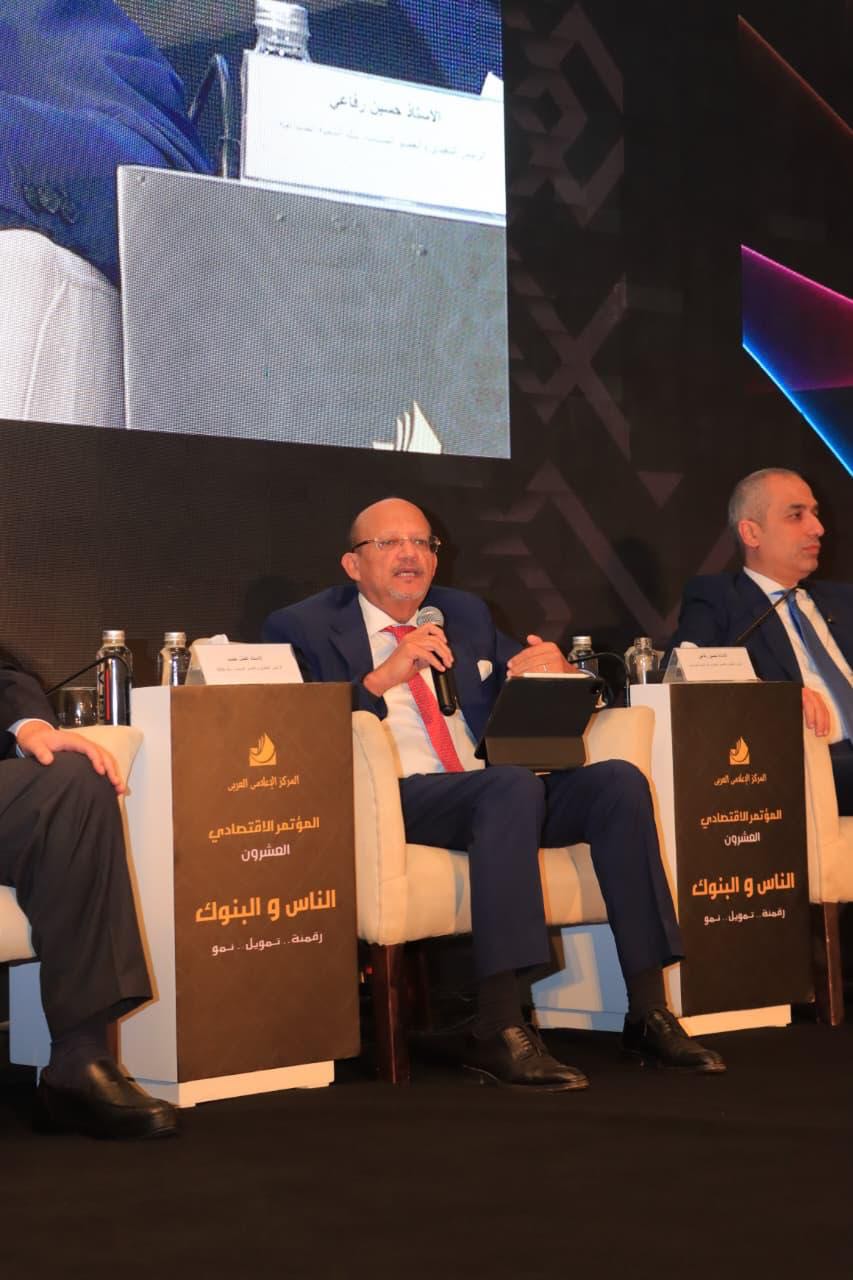
Hussein Refaie: Industrial Development Bank Strengthens Its Position as a Comprehensive Commercial Bank, While Industrial Development Requires Specialized Financing and an Integrated Banking Partnership
10 Nov, 2026Mr. Hussein Refai, CEO and Managing Director of the Industrial Development Bank (IDB), affirmed that increasing the industrial sector’s contribution to GDP cannot be achieved simply by injecting more financing. Rather, it requires directing funding toward activities with strong growth potential and the ability to generate genuine added value, thereby supporting local production and enhancing the competitiveness of the Egyptian economy.
Refaie made these remarks during his participation in the second panel discussion, entitled “Bank Financing: A Driver of Economic Growth,” held as part of the 20th edition of the People and Banks Conference. During the session, he outlined the Industrial Development Bank’s vision for supporting Egyptian industry and highlighted the role of the banking sector in translating the objectives of the national industrial strategy into viable projects and sustainable investments.
Refaie explained that the Industrial Development Bank continues to implement its transformation and expansion strategy as a comprehensive commercial bank, offering an integrated range of banking services and solutions to various customer segments and economic sectors, while leveraging its longstanding expertise and specialization in industrial financing, which remains one of its key competitive advantages.
Regarding the importance of technology and digital transformation in developing banking services, Refaie noted that the cost of establishing and equipping a single bank branch currently ranges between EGP 30 million and EGP 50 million, depending on its size. Costs may rise further if the bank purchases the premises.
He explained that directing investments toward technology and digital solutions enables banks to reach a broader customer base across a wider geographical area and at greater speed, compared with relying solely on traditional branch expansion.
He added that customer banking behavior has changed significantly. Customers no longer need to spend considerable time visiting branches to complete their transactions, as they did in the past. Instead, they increasingly expect to access banking services and complete transactions within minutes, from anywhere, through available digital channels.
Refaie stressed that technology has become essential for saving customers’ and banking employees’ time and effort, improving operational efficiency, and rationalizing expenses, particularly amid continuously rising operating costs. This makes investment in digital transformation a key pillar in developing the banking sector and strengthening its competitiveness.
Refaie also explained that Egypt’s Industrial Strategy for 2026–2030 views industry as an integrated ecosystem built around several key pillars, including strategic programs, human capital development, product development, streamlining operations and procedures, innovation and incentive mechanisms, and performance measurement indicators.
He noted that the Ministry of Industry is responsible for establishing the overall framework and policies governing the industrial ecosystem.
The banking sector, meanwhile, serves as a financial and strategic partner in translating this framework into tangible projects and investments by identifying Egypt’s competitive advantages and directing investments and financing toward activities with genuine opportunities for growth, expansion, and competitiveness.
Refaie pointed out that one of the main pillars of the Industrial Development Bank’s strategy is deepening local manufacturing and developing supply chains. He emphasized that financing should not be limited to final industrial products but should also extend to supporting feeder industries, component suppliers, and related services.
Citing the automotive industry as an example, he explained that support should not be confined to financing car assembly plants. Instead, it should extend to local suppliers, component manufacturers, and spare parts producers, thereby achieving greater integration across production stages, increasing local added value, and reducing reliance on imports.
Refaie emphasized the importance of directing financing toward sectors in which Egypt enjoys genuine competitive advantages and has the capacity to expand and export. He noted that the objective is not necessarily for Egypt to operate in every industrial activity, but rather to focus on sectors where the country has the capabilities and potential to build sustainable productive and export opportunities.
He also highlighted the importance of supporting technological modernization, innovation, and sustainability, stressing that the industries best positioned to compete in the future will be those offering greater efficiency, higher quality, and stronger innovation capabilities. Modernizing production lines, adopting advanced technologies, and improving resource efficiency are essential elements in enhancing the competitiveness of Egyptian products.
In this context, Refaie underscored the importance of expanding the industrial base through small and medium-sized enterprises (SMEs), describing them as a fundamental component of industrial integration. Large factories cannot achieve such integration independently; they require a strong network of suppliers and SMEs connected to their supply chains.
He further highlighted the importance of leveraging the comparative advantages of individual governorates and regions by developing a clear map of the competitive strengths of Egypt’s governorates and villages. This would help direct investments and financing toward activities best suited to each region, creating a more diversified and integrated productive base.
Refaie stressed that human capital development and improving the capabilities of SMEs are essential aspects of industrial support. He explained that the challenge is not merely helping small businesses produce high-quality products, but also enabling them to maintain consistent quality standards as they expand and increase production volumes to meet growing demand.
He noted that the Industrial Development Bank can play an important role in helping these businesses transition from small-scale production to larger-scale operations while maintaining consistent quality standards. This would qualify them to become reliable suppliers to major factories and companies and facilitate their integration into supply chains.
Refaie added that strengthening partnerships with commercial and industrial chambers, specialized associations, and business associations represents another important pillar of the bank’s vision. These organizations serve as a vital link between the banking sector and the industrial and investment communities, as they are best positioned to identify investors’ and manufacturers’ needs and understand the actual challenges they face.
Refaie also revealed the bank’s intention to develop a more specialized banking model tailored to different economic activities by understanding the nature of each industry, its financing requirements, and its operating cycles. This would enable the bank to provide more appropriate and faster financing solutions.
Among the proposed initiatives is the introduction of specialized fast-track channels for different industrial activities. Under this approach, dedicated employees with in-depth knowledge of specific industries, their requirements, and operating cycles would handle customer requests, enabling faster assessment and more efficient delivery of appropriate financing solutions.
Refaie emphasized that this approach reflects the Industrial Development Bank’s ambition to become a financial and strategic partner to industry rather than merely a financing institution.
He reiterated that increasing industry’s contribution to GDP requires directing financing toward activities that generate genuine added value and support production, employment, and exports.
Refaie concluded by reaffirming that industry lies at the heart of the Industrial Development Bank’s identity, stressing that the bank continues to develop its banking instruments and solutions to meet the needs of various industrial sectors and support the development of a more integrated, productive, and competitive Egyptian industrial base.